
Dhamma-pāla Jātaka
Dhamma-pāla Jātaka
In the celestial realm, where clouds of spun gold drifted across an endless sapphire sky, lived a being of immense virtue and radiant compassion. This being, in a life long past, had been a noble prince named Dhamma-pāla, whose very name meant 'Protector of the Dhamma,' or the righteous way. He was born into a kingdom that was prosperous but teetering on the brink of moral decay, a kingdom where greed and injustice were slowly poisoning the hearts of its people.
Prince Dhamma-pāla was unlike any other royal. While his peers reveled in luxury and indulged in frivolous pursuits, he spent his days studying ancient scriptures, practicing meditation, and engaging in acts of selfless service. His father, the king, a man deeply engrossed in worldly affairs, often chided him. 'My son,' he would say, his voice tinged with impatience, 'why do you waste your time with these dusty scrolls and silent contemplation? A prince must learn the art of war, the intricacies of governance, and the pleasures of the court. That is the path to true power and renown!'
But Dhamma-pāla would gently reply, 'Father, true power lies not in the sword or the crown, but in the cultivation of righteousness within oneself and the upholding of justice for all. A kingdom built on greed will crumble, but one founded on the Dhamma will endure.'
As Dhamma-pāla grew, his reputation for wisdom and compassion spread far beyond the palace walls. He established charitable dispensaries, offered counsel to the distressed, and ensured that the laws of the land were applied with fairness, even to the humblest peasant. He was a living embodiment of the principles he cherished.
However, not all were pleased with the prince's growing influence. In the court resided a scheming minister, a man whose heart was as dark as his intentions were malicious. This minister, known for his avarice and his cunning manipulation of the king, saw Dhamma-pāla as a threat to his own power and influence. He whispered venomous lies into the king's ear, portraying the prince as naive, disloyal, and unfit to rule. 'Your Majesty,' the minister would say, his voice dripping with feigned concern, 'the prince's obsession with the Dhamma makes him weak. He neglects the kingdom's defenses and alienates our allies with his overly compassionate policies. He is a danger to your throne!'
The king, though initially fond of his son, was susceptible to the minister's flattery and insidious counsel. He began to view Dhamma-pāla with suspicion, his love for his son slowly eroding under the weight of the minister's fabrications.
One day, the minister devised a wicked plot. He orchestrated a minor border skirmish, exaggerating the threat to the kingdom. Then, he approached the king with a plan that he presented as a strategic necessity. 'Your Majesty,' he declared, 'to quell this uprising and secure our borders, we must send a powerful delegation to negotiate with the neighboring kingdom. And who better to lead this delegation than Prince Dhamma-pāla? His gentle nature, they say, is well-respected there. Let him go, and I am certain he will secure a lasting peace.'
The king, blinded by the minister's cunning words, agreed. He summoned Dhamma-pāla and announced his mission. The prince, though he sensed the underlying danger, accepted his father's command with grace. He knew that his duty was to serve the kingdom, even if it meant venturing into peril.
As Dhamma-pāla prepared for his journey, the minister secretly instructed a band of assassins to intercept the prince on his way to the border. 'Ensure that he never reaches his destination,' the minister commanded, his eyes gleaming with cruel satisfaction. 'Make it look like the work of bandits or the enemy.'
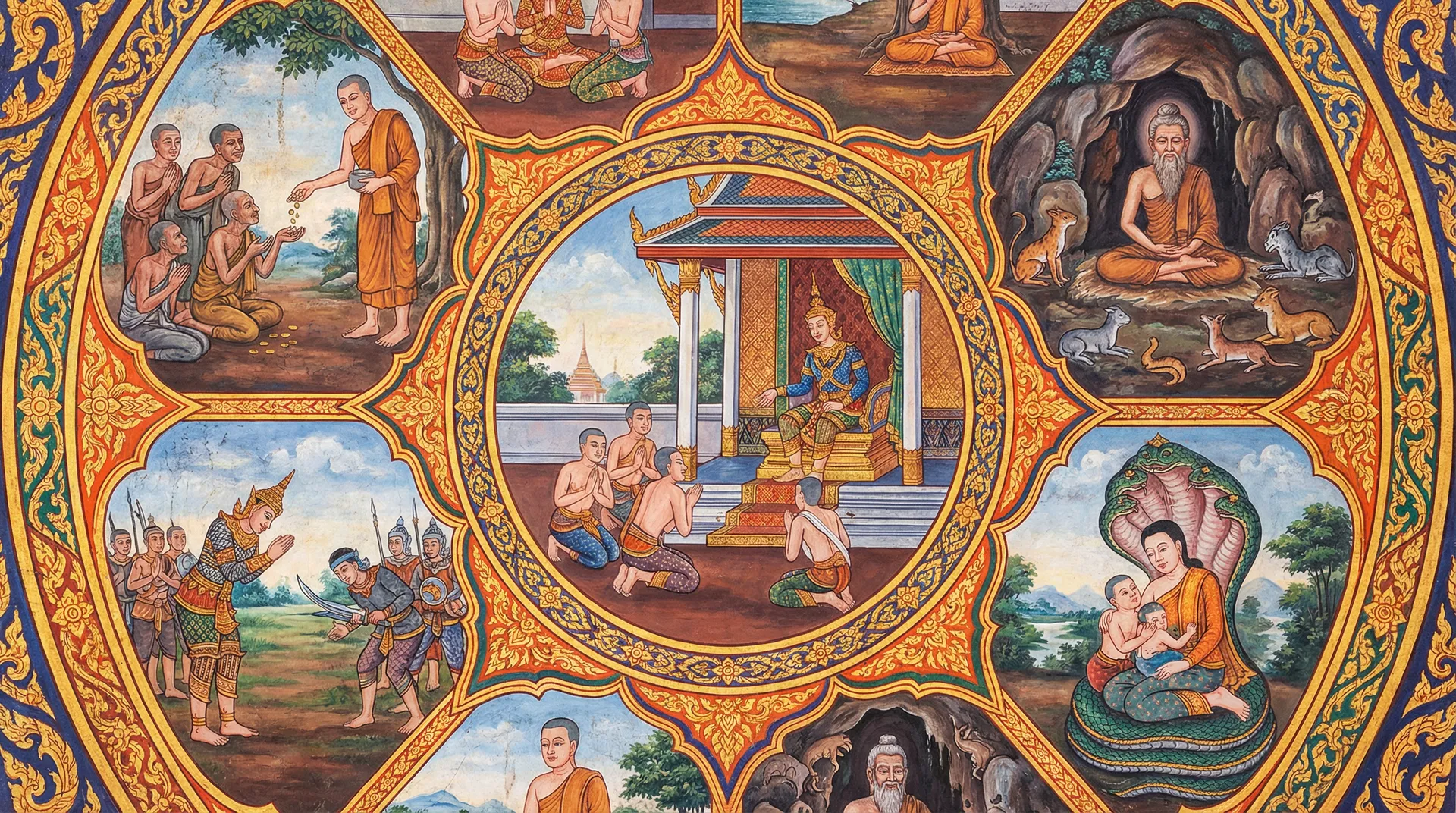
Dhamma-pāla, accompanied by a small retinue of loyal guards, set out on his diplomatic mission. As they traveled through a remote mountain pass, the assassins sprang their trap. They attacked with ferocity, intent on their deadly task. Dhamma-pāla's guards fought bravely, but they were outnumbered and outmatched. Seeing his companions fall, Dhamma-pāla knew he could not escape.
Instead of fighting, he did something extraordinary. He disarmed himself, raised his hands in a gesture of peace, and addressed the lead assassin. 'My friend,' he said, his voice calm and unwavering, 'I understand you have been sent to take my life. But I ask you, before you commit this act, consider this: what have I ever done to harm you? What have I done to deserve such a fate? If it is my life you seek, then take it. But know that I forgive you, and I wish you no ill will.'
The assassins were taken aback by the prince's composure and his lack of resistance. They had expected a fight, perhaps pleas for mercy, but not this profound acceptance and forgiveness. The leader, a hardened man, felt a flicker of doubt. He looked at the prince, whose eyes radiated a serene light, a light that seemed to pierce through his darkness.
Just as the assassins were about to strike, a troop of royal soldiers, alerted by a loyal servant who had overheard the minister's plot, burst into the pass. They quickly subdued the assassins, capturing them and their leader. The prince was safe.
The captured assassins, interrogated by the royal soldiers, confessed the entire plot, implicating the treacherous minister. The king, upon hearing the truth, was horrified by his own folly and the depth of the minister's betrayal. He ordered the minister's immediate arrest and punishment.
Prince Dhamma-pāla, having fulfilled his duty and demonstrated the unwavering strength of his principles, returned to his father's side. The king, filled with remorse, begged for his son's forgiveness. 'My son,' he wept, 'I have been a fool. My judgment was clouded by deceit. You are the true jewel of this kingdom.'
Dhamma-pāla embraced his father. 'Father,' he said, 'let us not dwell on the past. Let us learn from this experience. The Dhamma teaches us that even in the face of betrayal, we must hold fast to compassion and truth. Forgiveness is not weakness; it is the greatest strength.'
From that day forward, the king ruled with renewed wisdom, guided by his son's unwavering example. Prince Dhamma-pāla, the Protector of the Dhamma, continued to serve his kingdom, ensuring that justice, truth, and compassion prevailed, becoming a legend whose virtue shone brightly through the ages.
— In-Article Ad —
💡Moral of the Story
True strength lies in compassion, forgiveness, and adherence to righteousness, even in the face of adversity and betrayal.
Perfection: Compassion (Karuna)
— Ad Space (728x90) —
More Jataka Tales You May Enjoy
 357Pañcakanipāta
Sattubhatta Jataka
Sattubhatta Jataka Long ago, in a time when gods and humans walked more closely, the great Bodhisatt...
💡 True wealth is not measured by possessions, but by generosity and the well-being of others. Greed leads to emptiness, while sharing brings true satisfaction and prosperity.
 118Ekanipāta
Udaya Jataka
Udaya Jataka In the kingdom of Mithila, a land renowned for its skilled artisans and vibrant markets...
💡 True wisdom lies in discerning truth from falsehood, and in valuing integrity and honesty above material gain or superficial promises. Appearances can be deceiving; a sharp mind and a pure heart are the best defenses against deception.
 232Dukanipāta
Phra Ong Khong Khon (The Bodhisatta as a King Who Values Honesty)
Phra Ong Khong Khon (The Bodhisatta as a King Who Values Honesty) In the bustling city of Varanasi, ...
💡 Honesty is the most valuable treasure, far surpassing any material wealth. True worth lies in integrity and truthfulness, which form the bedrock of a just and prosperous society.
88EkanipātaThe Great Dream Jataka
In ages past, when the Bodhisatta was cultivating his perfections, he was born as King Brahmattat, a...
💡 Blind suspicion and unfounded jealousy, fueled by deceit, can lead to great injustice. Truth and righteousness, patiently sought and revealed, are the only paths to healing and true reconciliation.
55EkanipātaThe Bodhisatta as the Young Brahmin
The Bodhisatta as the Young BrahminIn the ancient city of Ujjain, a place of profound spiritual lear...
💡 Selfless service and pure compassion, born from a heart devoted to alleviating suffering, can overcome even the greatest adversities and reveal the divine within.
111EkanipātaBhūridatta Jātaka
Bhūridatta Jātaka Long ago, in the mystical kingdom of Indapatta, there lived a wise and benevolent ...
💡 True strength lies not in subjugating others, but in compassion and self-sacrifice. Wisdom and kindness can transform even the most hardened hearts.
— Multiplex Ad —